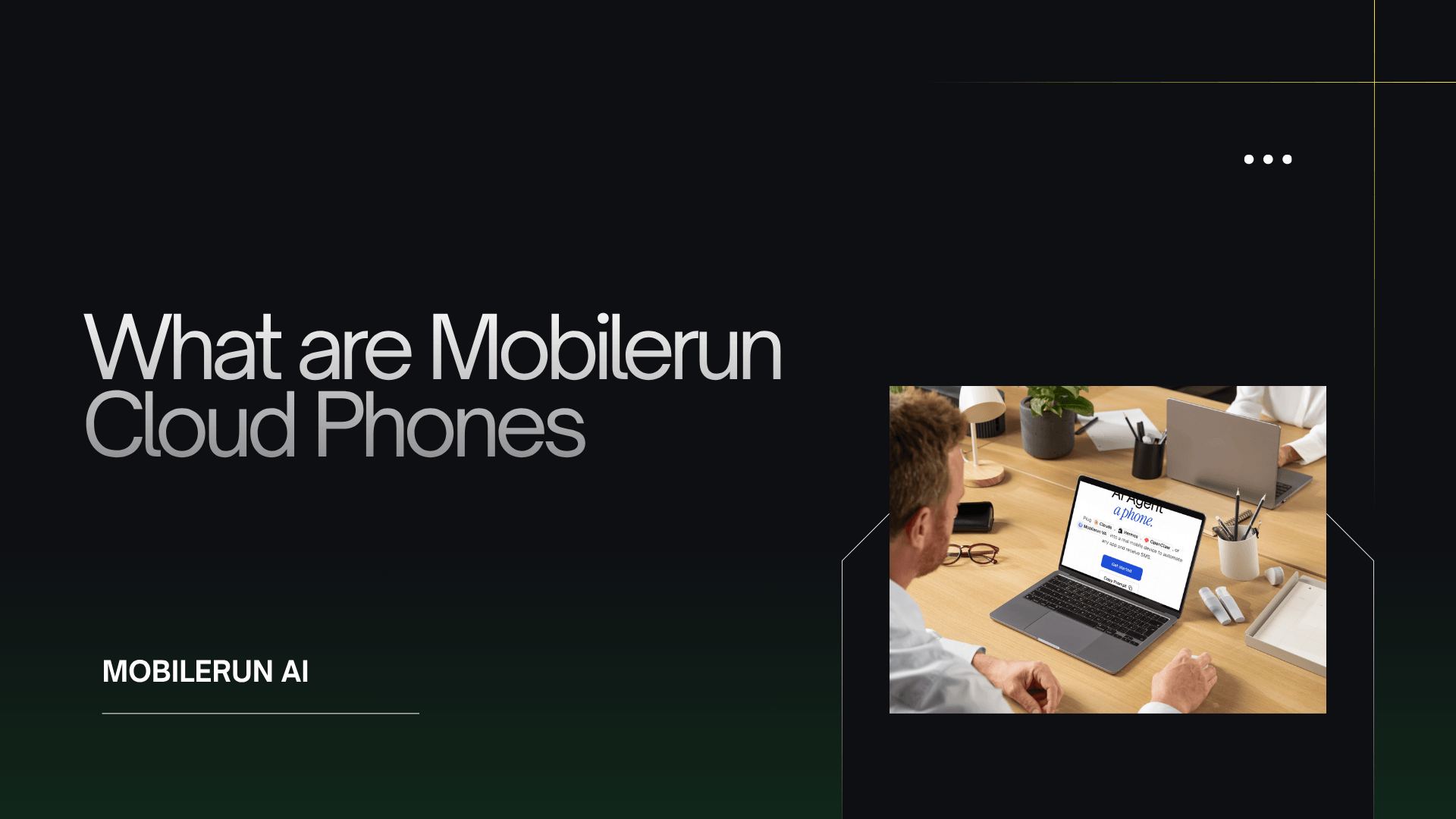
Cloud phones have become increasingly important as businesses, developers, QA teams, and automation platforms look for ways to run mobile applications remotely. Instead of relying on a device sitting on a desk, cloud phones allow phone emulators or even physical smartphones to be accessed through cloud infrastructure from anywhere in the world.
This article explains what cloud phones are, how they work, where they are used, and how Mobilerun's approach differs from many traditional cloud phone providers.
What are cloud phones
A cloud phone is a virtual mobile device that runs on remote servers instead of on hardware you hold. It works just like a real smartphone, running apps, managing accounts, and interacting with mobile services while the operating system and apps run in the cloud. Users reach the device through a web interface or a client app and interact with it much as they would a physical handset.
Because the processing happens in the cloud instead of on the phone, you can scale this to multiple devices. Heavy tasks like gaming, managing multiple accounts or apps, can run continuously without draining the battery or overheating your real phone.
How cloud phones work
Most cloud phones follow a similar architecture including device infra, streaming layer, control layer and persistence.
1. Device Infrastructure
A provider hosts Android/iOS environments on remote infrastructure. Depending on the platform, these may be:
1. Virtual Android devices
2. Real physical smartphones housed in data centers
2. Streaming Layer
The device screen is streamed to the user in real time. The user sees the mobile interface and can interact with it as if holding the phone directly (img)
3. Control Layer
User actions such as taps, swipes, text input, app installation, screenshots, and file transfers are transmitted back to the device. This creates a fully interactive remote mobile experience.
4. Persistence
Many cloud phone platforms allow device state to persist across sessions. Applications remain installed, account logins are preserved, and files stay available even after the user disconnects.
What cloud phones are used for
Businesses use these cloud phones for tasks like mobile app testing and QA, mobile account management, e-commerce operations, gaming, and separating work from personal use on a single handset.
How Mobilerun's cloud phones differ
Mobilerun supports multiple device models rather than a single type of cloud device. These models are personal physical phones, Virtual Cloud phones, and Physical–phone-in-the-Cloud.
It helps to separate three distinct setups. A personal physical phone is a real device you own and operate on a daily basis.
A virtual cloud phone is an emulated Android instance on a server, cheap to spin up and easy to scale, but software-based.
A physical phone in the cloud is a real Android/iOS device hosted in a remote data center that you access over the network; it runs on ARM hardware with genuine device identifiers such as IMEI and MAC, which apps tend to read as a normal phone.

A Key Difference : AI-Native Automation
Many cloud phone platforms primarily focus on providing remote Android access. Mobilerun's documented focus is broader: enabling AI agents to operate mobile devices(Android and iOS) through a multi-agent automation architecture.
Mobilerun allows Android and iOS devices to be controlled through intelligent agents capable of planning and executing workflows. The architecture includes orchestration, planning, and execution components designed specifically for mobile automation and saving these workflows.
This means the device is not only accessible remotely but can also become part of larger automated workflows powered by AI agents.
Conclusion :
Cloud phones are the result of years of progress in mobile cloud computing, virtualization, and remote device management. They provide a practical way to access Android/iOS environments without maintaining large fleets of physical hardware.
Today's market includes several approaches, ranging from virtual Android environments to real physical phones hosted in data centers. Each option offers different trade-offs in scalability, cost, persistence, and hardware fidelity.
Mobilerun's approach is notable because it combines multiple device types like temporary emulators, dedicated cloud phones, personal phones, and physical phones in the cloud with an AI-driven automation framework designed to operate those devices programmatically. And this combination of device infrastructure and agent-based automation is a distinguishing characteristic of the platform.
more from
the blog
Doubao vs Mobilerun: Detailed Comparison
Compare Doubao and Mobilerun across automation capabilities, real-device support, cloud execution, and AI agents to find the best platform for your needs.
How to Automate Mobile App QA Without Writing Scripts
Mobile applications are becoming more dynamic, AI-powered, and personalized. Static automation scripts struggle to keep pace with these changes. let's see how you can automate mobile app QA without writing scripts. Scripts
Mobilerun vs DuoPlus: Which Cloud Phone Platform Fits Your Workflow?
Both Mobilerun and DuoPlus put mobile devices in the cloud and let you automate them and both can run many social media accounts at scale with automation.